Historical story · 3 min read
Warm feet and crowded benches: inside the Synod of Dort
The Synod of Dort was a theological gathering with very practical needs. Its delegates required somewhere to sit, write, hear one another, and stay warm. The room and its furnishings offer a closer view of their work in 1618–1619.
Published
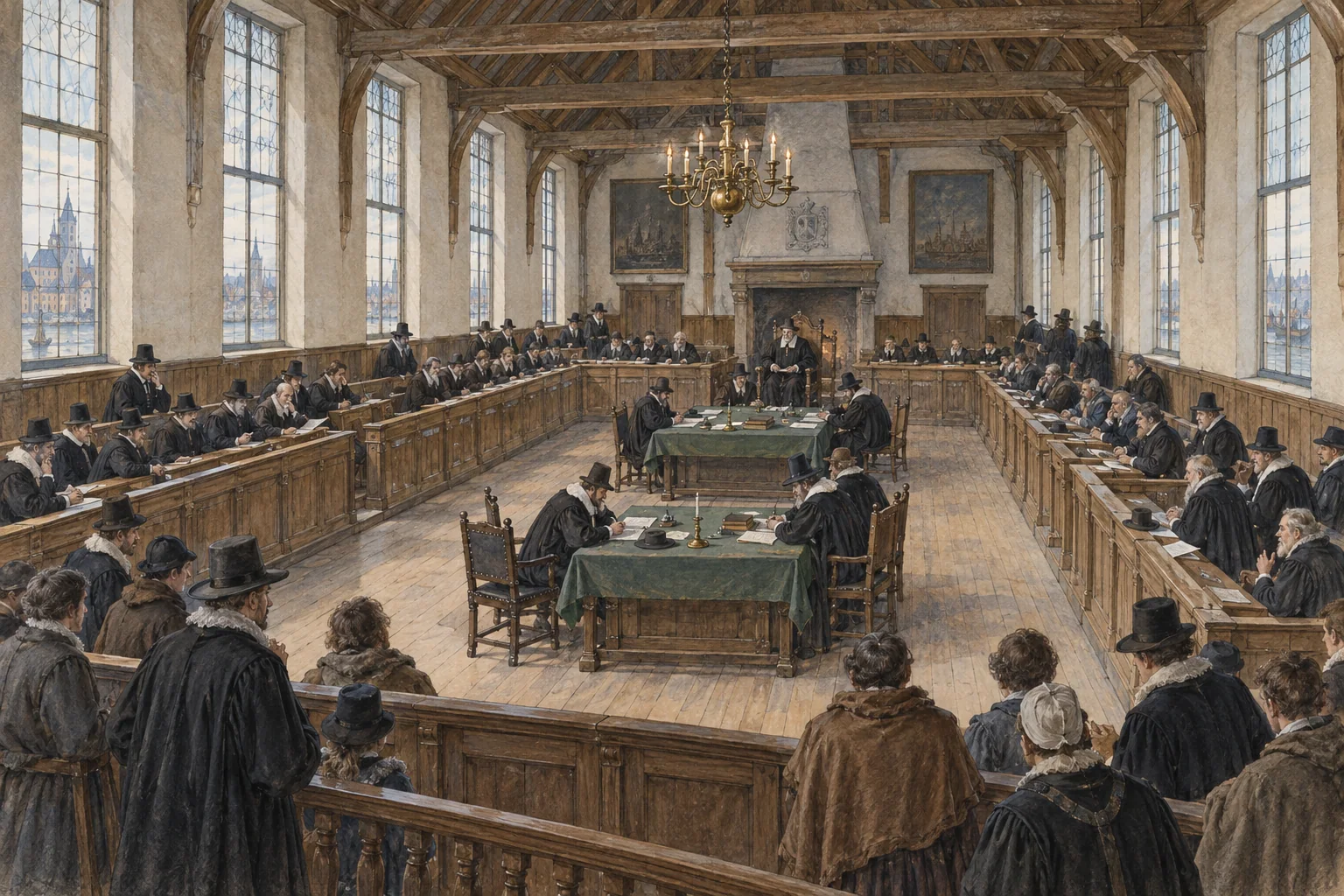
The meeting room in the Kloveniersdoelen
The synod’s opening worship took place in the Grote Kerk on 13 November 1618. The delegates then began their meetings in an upper room of the Kloveniersdoelen, a building used by Dordrecht’s civic guard. The Grote Kerk’s historical account describes the move from the church to the meeting hall.
Within that civic setting, delegates read, listened, debated doctrine, and reached the decisions of a church assembly. The room brought these different tasks together. Written accounts and surviving representations let us examine both the theological work and the practical setting in which it happened.
The practical business of a winter meeting
Historian Jo Spaans describes the arrangements that made the room usable: specially provided tables and benches, a fireplace, and individual foot warmers. A room that could be heated offered advantages over a church for a gathering extending through winter.
The seating also reflected the standing of the bodies represented. Spaans notes that places were reserved for French representatives whose king prevented them from coming. Even an unoccupied place could therefore say something about the assembly’s international setting.
Long deliberations required furniture, accommodation, organisation, and the practical support of people beyond those whose names appear under the decisions. These arrangements made the assembly’s work possible.
A picture of the synod printed on silk
One remarkable surviving object is a 1619 engraving by François Schillemans printed on silk, preserved by the Rijksmuseum. Its numbered explanation and poem by Jacob Cats make it more than a silent view of a room. It presents the gathering to an audience.
The broad arrangement seen in Schillemans’s representation includes timber overhead, windows along the sides, writing tables, perimeter seating, and observers. These features informed the artistic reconstruction above. Its individual faces, proportions, and decorative details remain imagined.
The material of the museum object adds another point of interest. A historical image could circulate as a commemorative object, not simply as a neutral record. A reader should ask both what it shows and how it wants the event to be remembered.
Reading pictures from different periods
The Rijksmuseum also preserves a 1729 copy after Schillemans, produced under Bernard Picart’s supervision. It shows how the earlier representation continued to shape images of the synod more than a century later.
Johannes Rutten’s 1836 drawing of the room records the hall’s later appearance. Reading it alongside the 1619 engraving helps distinguish the history of the building from representations of the assembly itself.
For the debates and decisions behind these pictures, read the history of the synod and the guide to its doctrinal articles. The pictures show how the meeting was represented; the Canons set out what the assembly taught.
Sources and further reading
These guides explain the text from a Reformed perspective. They are original editorial commentary, separate from the historic confession and its published translation.
- Grote Kerk Dordrecht: The KloveniersdoelenLocal historical account identifying the meeting venue.
- Grote Kerk Dordrecht: HistoryOpening worship on 13 November 1618 and the first meeting in the Kloveniersdoelen.
- Jo Spaans: De synode van DordrechtScholarly account of the hall’s arrangements, heating, and representative seating.
- Rijksmuseum: Schillemans’s 1619 engraving on silkObject RP-P-OB-77.279, with explanatory key and Jacob Cats’s poem.
- Rijksmuseum: Picart’s 1729 printThe museum attributes supervision of this 1729 copy after Schillemans to Bernard Picart.
- Rijksmuseum: Rutten’s 1836 drawingA later view of the room, not a contemporary synod scene.